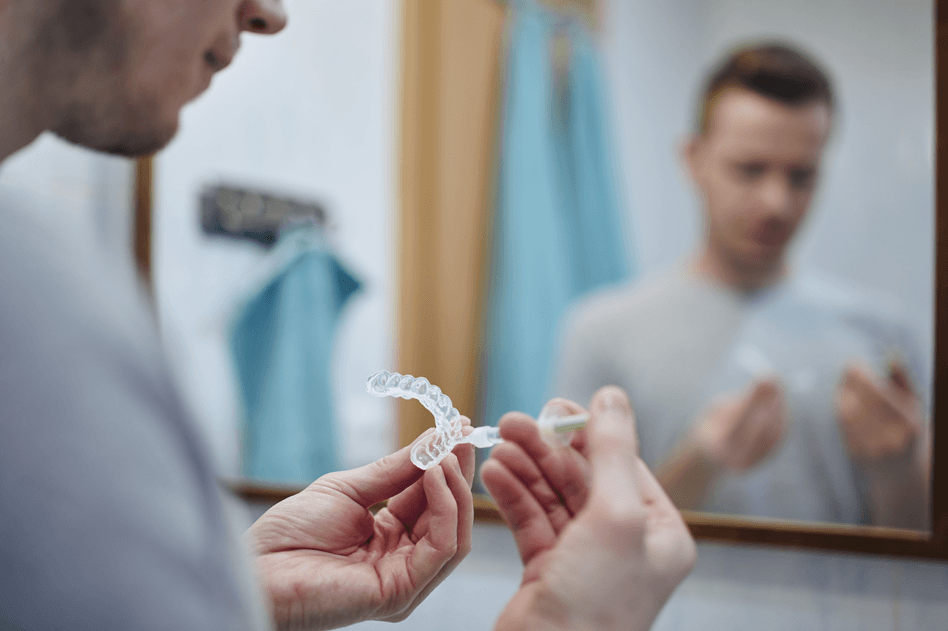
Invisalign is a widely used tool to straighten teeth without bulky, painful, and obvious metal braces. Instead, clear, flexible trays are used to realign the teeth without anyone ever knowing. Although these clear aligners are the more discreet option, they work just as well as traditional braces. There is no need for brackets and wires; this modern technology streamlines and simplifies the process of orthodontic realignment.
Our clients usually come to us with the same most common inquiries and questions. How does Invisalign actually work? To answer this, we need to spend a little time explaining the technology and the advances that were used to create and produce clear aligners.
The Science of Invisalign Clear Aligners
To explain this in the simplest way possible, the idea of Invisalign is to shift and reposition the teeth to an ideal location in a gradual and systematic way.
This idea is incredibly straight forward and simple, and unfortunately, many people may not realize how difficult and complex this actually is. The teeth shift through a slow and consistent application of pressure to support the organs that surround the teeth and jaw.
There is a lot of technology that exists in the field of orthodontics that supports the movement of the teeth in conjunction with the jaw, ligaments, and tissues. Classic braces are another example of this technology that uses wires and brackets.
Each new aligner set is custom-designed to gradually move your teeth, one step closer each appointment, along your journey with Invisalign. You can think of the process like climbing stairs. Instead of jumping directly to the top, you move one step at a time.
It Starts with a Digital Scan
One of the most impressive aspects of Invisalign technology is what they do before the beginning of the process.
Traditionally, orthodontic treatment began with the doctors’ painstaking creation of a mould of the patient’s teeth. Patients had to bite, literally, down upon trays filled with impression putty.
Not any longer.
Invisalign uses an advanced, time-saving, and patient-friendly (no more putty!) process.
At DentaAesthetica Dental Clinic, an orthodontically specialized, high-tech digital scanner removes the guesswork and replaces it with a highly detailed and precise, three-dimensional image of your mouth and bite.
Patients enjoy seeing a digitally constructed and flawless version of their smile on the computer and in 3-D. This will be the starting point of your treatment plan.
Crafting a Customized Treatment Plan
Once the digital scan is finished, specialized Invisalign software is used to digitally and automatically map the personalized treatment plan of an orthodontist for that specific patient.
The software also enables the clinician to create an optimized path for the movement of the patient’s teeth and design the necessary aligners to achieve this objective.
One of the most exciting features is the ability to preview your future smile.
Seeing a digital preview of their post-treatment smile helps patients understand the results they can expect from the Invisalign program.
It’s like getting the final image for a puzzle you haven’t yet started.
How Aligners Act on Teeth
Invisalign makes use of multiple aligners that each exert a soft, precise, and controlled pressure on teeth to move them.
The creation of each new aligner incorporates the shifts of your smile from the use of the prior aligner.
The aligners work by applying consistent pressure to select teeth.
Invisalign dynamically engages the biological processes of the jaw.
As the tooth moves, the jawbone that previously supported it on one side is broken down by bone resorption, leaving room for the new position. And bone tissue on the other side forms in support of the tooth.
Invisalign’s gradual design means that treatment, on average, lasts several months.
Small movements over time lead to significant changes.
The Purpose of Multiple Aligners
Patients are often taken aback by the number of aligners used in the process. A common question is: why can’t the teeth just be moved into the final position with one aligner?
The answer to that is in the guiding principles of biology.
Too much pressure on the teeth all at once can destabilize the tissue surrounding the teeth. To avoid that, the Invisalign design breaks the movement down to a safe series of steps.
Each aligner is responsible for a unique action in the overall process, while the next aligner in the series takes over after it is done.
It is much more strategic to stay on the path rather than making shortcuts that lead to problems down the road.
How SmartTrack Material Works
Invisalign has the advantage of using SmartTrack material.
It has been made specifically to enhance the performance of the aligners.
SmartTrack aligners can be made to fit perfectly, apply force evenly and be more comfortable.
Patients claim that the Invisalign aligners are smooth and comfortable, in contrast to braces.
It is also helping along the more predictable movement of the teeth, making the results of the treatment more reliable.
It may seem trivial, but the material of the treatment can have a huge effect on the comfort and the effectiveness of the treatment.
Invisalign Attachments
Patients undergoing treatment with Invisalign may need small, colored, tooth attachments.
Attachments are small, temporary, bonded to teeth, and shaped.
They work like small handles that the aligners can grip.
Along with attachments, aligners are able to perform a higher degree of movement than is possible without them.
They are far less obvious than traditional braces, and most people are unaware of them after a few days.
Importance of Wearing Time
Invisalign relies on the customer more than anything.
Aligners need to be worn for 20 to 22 hours a day.
The planned force needs to be applied to the teeth in order to keep them moving to the correct position.
The treatment may be delayed if the aligners are removed too often.
Fortunately, most aligner users find the aligners easy to incorporate into their daily routines.
Monitoring Progress Throughout Invisalign Treatment
Invisalign treatment continues to involve more technology.
The patient will still have regular check-ups to let the dentist monitor the shifts in the position of the teeth.
They will need to make adjustments depending on the responsiveness of the patient.
Invisalign is well-known due to the absence of surprises, and that is largely thanks to the combination of digital techniques and expert supervision.
DentaAesthetica Dental Clinic uses the same strategy of frequent office visits to make sure that the patients achieve their preferred results in a timely fashion.
Beyond Aesthetics
Many people would be surprised to learn that more than just the aesthetics of the smile would be addressed by the use of Invisalign.
Invisalign may help correct:
- Teeth that are too close together or too far apart
- Overbites
- Underbites
- Crossbites
- Open bites
- Functional bite issues
Invisalign is both a treatment option that provides aesthetic and functional improvements.
Many patients will see such improvements.
Conclusion
The expertise that is involved in the development and application of the clear aligner treatment modality would amaze many people. A treatment option that incorporates sophisticated digital technology, the use of advanced materials, contemporary practice in applied biological science and an evidence-based approach to clinical treatment is clearly excellent. The treatment is not only effective; it is safe and allows for predictable tooth movement thanks to the digital imaging and printing of individualized aligners complemented by expert supervision throughout the treatment.
At DentaAesthetica Dental Clinic, we utilize the best technology and the best people to get the best results with our Invisalign. We treat crowded teeth, gaps, and bite problems. But first, let’s go over some important information about the most popular orthodontic treatment option.
Frequently Asked Questions
1. How does the Invisalign system of orthodontics shift and align teeth?
Through the use of a system of aligners, Invisalign applies a steady and gentle enhancement of pressure and shifts each designated tooth to the desired location over time.
2. What are the advanced and intriguing systems that Invisalign uses?
Invisalign includes a system of technology that greatly enhances the accuracy and comfort of the system through the use of advanced digital scanning, treatment-custom 3D aligner software and the patented SmartTrack material.
3. What are the restrictions when using the Invisalign aligners?
Invisalign may be removed for instances which require daily activities like eating or brushing; however, the aligners must be retained at all other times for a period of 20 to 22 hours.